
Medical Device CNC Machining Services in Thailand
Disk Precision provides medical CNC machining services to support the production of high-accuracy components for the medical sector. Our precision engineering capabilities are applied to parts used in medical devices and equipment, where consistent tolerances and controlled manufacturing processes are required. With operations supporting industries in Thailand and across Southeast Asia, we deliver reliable machining solutions for both regulated and specialised applications.
Precision CNC-Machined Components for Medical Device Manufacturing in Thailand
We produce precision CNC-machined components used in medical device manufacturing, supporting applications that require controlled tolerances, consistent quality, and reliable performance across production.
Surgical Instrument Components
We machine components used in surgical instruments, where dimensional accuracy and surface quality are important for consistent functionality. These parts are commonly used in equipment supporting surgical procedures and clinical environments.

Medical Pump and Valve Parts
Our machining capabilities support the production of pump and valve components used in medical systems. These parts require precise dimensions to ensure proper flow control and reliable operation in equipment used across healthcare applications in Thailand.

Diagnostic Equipment Housings
We manufacture housings and structural components for diagnostic equipment, ensuring proper alignment and protection of internal systems. These parts are used in devices supporting testing and monitoring functions.

Orthopaedic Device Components
We produce components used in orthopaedic devices, where strength, durability, and precision are required. These parts support applications that involve structural load and alignment.

Precision Brackets and Structural Parts
We machine brackets and structural components used in medical equipment and supporting systems. These parts provide stability and support for assemblies used in healthcare and specialised industrial environments.
Why CNC Machining Is Used in Medical Device Manufacturing in Thailand
CNC machining is widely used in medical device manufacturing due to its ability to produce precise, repeatable components while meeting regulatory and quality requirements.
CNC machining enables tight tolerances required for medical device components, ensuring consistent performance and reliability across applications.
Advanced CNC machining processes allow the production of complex geometries and detailed features required in medical equipment and device assemblies.
CNC machining ensures repeatability across production runs, supporting consistent quality for components used in regulated environments. Compliance with Thailand FDA medical device requirements helps ensure that manufacturing processes align with regulatory standards for medical devices in Thailand.
CNC machining supports both prototyping and full-scale production, allowing manufacturers to transition efficiently from design validation to volume manufacturing.

CNC Machining Capabilities for Medical Device Components
Our machining capabilities support the production of medical device components through a range of precision processes, including medical CNC machining services applied across different manufacturing requirements.
Our CNC milling services support the machining of complex and multi-surface components used in medical equipment and devices.
Our CNC turning service enables the production of cylindrical components with high accuracy, suitable for shafts, connectors, and rotational parts.
We provide supporting fabrication processes through metal fabrication in Singapore, enabling the production of structural components and assemblies used in medical equipment.

Materials Used in Medical Device CNC Machining
We machine a range of materials suitable for medical applications, depending on functional, structural, and environmental requirements.

Titanium Alloys for Medical Devices
Titanium is commonly used for implantable components due to its strength, corrosion resistance, and biocompatibility.

Stainless Steel for Surgical Instruments
Medical-grade stainless steel, such as 316L, is widely used for surgical tools and device components due to its durability and corrosion resistance.

Aluminium for Medical Equipment Components
Aluminium alloys are used in medical equipment housings and structural components where lightweight and strength are required.

Engineering Plastics for Medical Applications
Materials such as PEEK and PTFE are used in specialised medical devices and equipment where chemical resistance and stability are important.

Surface Treatments and Finishing for Medical Device Components
Medical device components often require specialised finishing processes to enhance durability, corrosion resistance, and cleanliness.
Anodising improves surface hardness and corrosion resistance, commonly applied to aluminium components.
Passivation enhances corrosion resistance for stainless steel components by removing surface contaminants.
This process provides uniform coating thickness and improves wear resistance for precision components.
Surface finishing processes improve smoothness and dimensional accuracy for components requiring tight tolerances.
Additional treatments are applied to protect components from environmental exposure and ensure long-term performance.
What Medical Device Components Can Be Produced with CNC Machining?
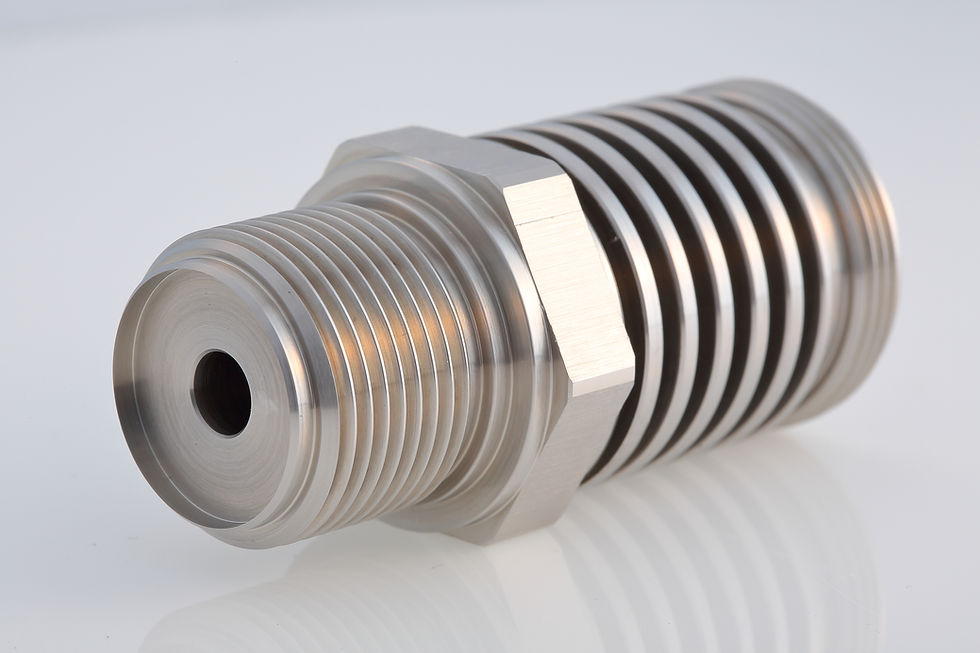
CNC machining supports the production of a wide range of medical components used in different applications. These components are produced using medical CNC machining services that ensure consistent quality, accuracy, and repeatability across production.
Components used in surgical tools require precision and consistent performance.
Parts used in orthopaedic applications where strength and structural integrity are required.
Components used in diagnostic devices supporting testing and monitoring systems.
Structural parts used in medical equipment assemblies and supporting systems.
Frequently Asked Questions About Medical Device CNC Machining
Understanding CNC machining for medical applications helps manufacturers evaluate suitable production methods and requirements.
Medical device components typically require tight tolerances, often within microns, depending on the application and regulatory requirements.
Common materials include titanium, stainless steel, aluminium, and engineering plastics such as PEEK and PTFE.
Yes, CNC machining supports prototyping, allowing manufacturers to validate designs before moving to full-scale production.
Common finishing processes include anodising, passivation, electroless nickel plating, and precision surface finishing to enhance durability and performance.