Inspection Strategy in Precision Engineering: Why It Matters as Much as Machining Accuracy
อัปเดตเมื่อ 6 พ.ค.

Introduction
In modern precision engineering environments, achieving tight machining tolerances is often viewed as the primary indicator of accuracy. Components produced through high-performance manufacturing processes may meet specified dimensions during machining, leading many to assume that precision has already been achieved. However, the reality is more complex. Precision in engineered components is only meaningful when those dimensions are systematically verified and consistently reproduced across batches and production cycles.
Dimensional accuracy becomes valuable only when it can be measured, interpreted, and validated against the design intent. This is where a structured inspection strategy plays an essential role. Rather than treating inspection as a final checkpoint after machining, it functions as a structured framework that connects design specifications, datums, and functional requirements to practical measurement processes on the shop floor. Through defined verification plans and measurement logic, theoretical machining accuracy can be translated into confirmed functional reliability.
Without a clear verification framework, even highly capable machining environments face risks that are not always visible during production. Parts may gradually drift away from intended alignment, small dimensional deviations may accumulate across assemblies, and latent variation patterns may remain undetected until later stages of manufacturing. These issues can lead to misalignment, reduced product reliability, or performance inconsistencies that machining capability alone cannot identify.
This challenge is particularly relevant in Thailand’s manufacturing sector, where the country serves as a major regional hub for electronics, industrial systems, and export-oriented component production. Manufacturers operating within these international supply networks are expected to provide traceable dimensional verification records that demonstrate how product accuracy is monitored throughout production. As global supply chains demand stronger traceability and tighter quality documentation, manufacturers are evaluated not only on their machining capabilities but also on their ability to demonstrate repeatable and verifiable performance.
For precision suppliers in sectors such as automotive, aerospace, and advanced electronics, consistently demonstrating accuracy is now just as important as achieving it in the first place. Global customers increasingly expect evidence that dimensional performance can be maintained across production runs, facilities, and long-term manufacturing programmes. In this environment, verification planning becomes a central part of the manufacturing discipline rather than a secondary activity performed after parts leave the machine.
Key Takeaways
Precision in manufacturing is not determined solely by how accurately a part can be machined, but by how reliably its dimensions can be verified and reproduced across real production conditions.
Structured verification processes help manufacturers detect variation early, interpret measurement data correctly, and maintain consistent dimensional performance across batches and production cycles.
A disciplined approach to measurement and validation reduces risks such as dimensional drift, tolerance stacking, assembly misalignment, and costly downstream rework.
Manufacturers that demonstrate clear and repeatable verification practices build stronger trust with global customers, especially in industries that require high reliability and strict quality documentation.
Why Inspection Strategy Is a Core Discipline in Precision Engineering

Machining Accuracy vs. Verified Accuracy: Understanding the Gap
Machining accuracy refers to the ability of manufacturing equipment and processes to produce parts within specified tolerance limits. Modern production environments use advanced equipment capable of achieving extremely tight tolerances, particularly in industries such as automotive systems, electronics components, and aerospace assemblies. Many of these parts are manufactured using precision CNC machining, where advanced machine control and stable tooling enable manufacturers to achieve extremely small dimensional deviations.
However, machining capability alone does not confirm that the finished component truly performs as intended. Verified accuracy refers to the measured reality of a component’s dimensions under controlled inspection conditions. This involves measurement procedures that confirm whether the produced features align with design specifications and functional requirements.
The difference between machining accuracy and verified accuracy is where many quality risks emerge. Parts may technically fall within tolerance bands yet still create downstream issues if variation clusters near tolerance limits or if alignment between multiple features is not properly evaluated. In high-precision environments, this distinction becomes especially important because dimensional results must be interpreted rather than simply accepted at face value.
Dimensional accuracy rarely exists as an absolute value. Instead, it operates within defined tolerance bands that allow for small variations. A component may technically pass inspection, yet still raise functional concerns if several features simultaneously approach their tolerance limits. In such cases, the underlying inspection strategy must determine where measurements fall within these bands, rather than relying solely on a simple pass-or-fail judgment.
Environmental influences, material behaviour, and machining process variation can also affect how parts behave after production. Temperature fluctuations, tool wear, and changes in machine calibration can gradually affect outcomes. These realities mean that machining results cannot be assumed to remain stable without careful monitoring.
For example, components used in aerospace assemblies often require precise positional relationships between mounting holes, bearing seats, and structural interfaces. Even when each feature meets its dimensional requirement, small positional shifts across multiple features can accumulate and affect final alignment during assembly. Without careful verification planning, such relationships may remain unnoticed until later stages of integration.
When inspection focuses only on confirming that dimensions fall within allowable limits, another risk can emerge. Measurement results may technically meet design specifications, but their closeness to the permitted limits may indicate a developing process issue. Rather than treating dimensional acceptance as a conclusion, a robust verification approach evaluates where the results fall within the acceptable range.
Another common challenge arises when inspection processes focus only on isolated measurements without monitoring variation trends across production batches. Without visibility into cumulative variation patterns, manufacturers may fail to recognise gradual drift in part dimensions. Over time, this can cause assembly issues or downstream quality problems that surface unexpectedly.
This is why structured inspection methodologies play a central role in advanced precision machining operations. Inspection planning defines how measurement data is interpreted, monitored, and compared over time. By doing so, manufacturers ensure that dimensional tolerances are not only achieved in individual parts but consistently maintained across production cycles.
In high-precision manufacturing sectors, this distinction becomes especially critical because even minor dimensional variations can affect long-term reliability. Components used in aerospace assemblies or high-speed mechanical systems often require precise alignment across multiple features. Even when individual parts appear compliant, accumulated variation can gradually reduce functional stability. A structured inspection strategy helps identify these patterns early before they affect downstream performance.

Why This Matters in Precision Manufacturing
Precision engineering is not judged solely by isolated machining success. Instead, it is evaluated through repeatability and consistency across production cycles. Manufacturers serving global supply chains must demonstrate that parts produced today will match those produced months or years later under the same design specifications.
An effective verification framework determines whether dimensional variation is properly understood and controlled or whether it remains hidden within the production process. When verification frameworks monitor measurement trends and interpret dimensional behaviour over time, engineers gain deeper visibility into process stability.
Without this analytical perspective, machining accuracy alone may create a misleading sense of control. Parts may appear compliant during individual inspections, yet long-term variation trends may go unnoticed. By integrating dimensional verification processes into production monitoring, manufacturers can ensure that measurements truly reflect the reliability of the underlying manufacturing process.
Modern inspection environments often combine coordinate measuring machines, optical inspection systems, and automated measurement software to capture dimensional data accurately and consistently. These technologies enable engineers to assess individual feature measurements alongside the relationships between them, providing a more comprehensive understanding of component behaviour during production.
Inspection Strategy as a Risk Management Framework
In precision engineering, inspection should not be treated merely as a final quality check. Instead, it functions as a form of engineering risk control. By identifying dimensional, measurement, and downstream performance risks early, manufacturers can address potential issues before they affect assemblies or customer applications.
This structured approach helps engineers determine where uncertainty is acceptable and where it must be eliminated. Certain dimensions may tolerate slight variation without affecting functionality, while others may govern alignment, sealing performance, or rotational balance. Through well-designed measurement planning, inspection processes can focus attention on features that directly influence product reliability.
Types of Risks Addressed Through Inspection Strategy
Dimensional risks often arise when variation accumulates gradually across production batches. Individual components may appear compliant when inspected separately, yet small shifts in dimensional behaviour can lead to long-term drift. These risks become more visible when verification systems monitor consistency across multiple manufacturing cycles.
Tolerance stacking represents another common dimensional concern. Components that individually meet tolerance requirements may still cause assembly issues when their tolerances interact within a complex mechanical system. When verification frameworks evaluate relationships between features rather than isolated measurements, such issues can be detected earlier.
Measurement risks also play a role in high-precision manufacturing. In some cases, inspection processes may focus on features that are easy to measure rather than those that govern real-world functionality. Over time, this can create blind spots in the verification process. A well-structured verification approach addresses this risk by aligning measurement activities with the functional features that influence part performance.
Downstream assembly risks also require careful attention. Some dimensional characteristics only become relevant when components interact with mating parts or are integrated into larger systems. Misalignment between inspected features and those that govern downstream fit or stability can lead to performance issues during assembly or field operation.
Gradual dimensional deviation can also remain hidden if inspection intervals are too widely spaced. A manufacturing process may appear stable during individual checks, yet small incremental shifts can accumulate over multiple production cycles. Continuous monitoring and interpretation of measurement results are crucial for maintaining long-term manufacturing reliability.
These risks become even more significant in global manufacturing environments where production consistency must be maintained across locations, suppliers, and long-term programme timelines.
Thailand-Specific Relevance
Thailand has established itself as a major manufacturing base supporting global OEM supply chains. Many precision component manufacturers in the country serve industries such as automotive systems, electronics manufacturing, industrial automation, and aerospace supply programmes. These industries place strong emphasis on documentation, traceability, and structured quality control.
International customers frequently rely on suppliers in Thailand to deliver large production volumes over extended programme timelines. As a result, suppliers must demonstrate not only machining capability but also the ability to maintain dimensional consistency across different production batches, manufacturing sites, and operational shifts.
For manufacturers operating within these international supply networks, a well-defined inspection strategy provides the organisational structure required to meet audit requirements and maintain customer confidence. Global OEMs often evaluate suppliers not only on their machining capabilities but also on how clearly and consistently they document verification processes.
In export-oriented manufacturing programmes, consistency across production sites becomes particularly important. When suppliers operate multiple facilities or supply components across extended timeframes, verification frameworks must ensure that dimensional performance remains stable regardless of location or personnel changes.
A disciplined inspection framework also supports long-term supply relationships by preserving traceable quality records. By maintaining robust tolerance-compliance documentation, manufacturers can demonstrate that dimensional requirements are consistently met throughout the production lifecycle.
Why Inspection Strategy Influences Cost, Lead Time, and Trust
Inspection activities are sometimes viewed purely as a cost centre within manufacturing operations. Because measurement requires specialised equipment and additional processing time, some organisations treat inspection as an unavoidable overhead rather than a strategic capability.
In practice, however, an effective inspection strategy also serves as a cost-control mechanism. By identifying dimensional risks early, manufacturers can prevent expensive downstream problems such as assembly failures, rework, and product recalls.
Poor inspection planning often increases production costs even when machining performance remains strong. When measurement processes fail to focus on critical features, undetected variation can lead to scrap, rework, or delivery delays later in the manufacturing cycle. A clearly defined verification framework helps ensure that measurement efforts align with the dimensions that truly influence product performance.
Strategic Implications
Excessive inspection can slow production throughput without providing additional confidence in part quality. When too many features are measured without a clear functional justification, manufacturing efficiency may decline without meaningful improvement in verification quality.
At the same time, insufficient inspection introduces a different set of risks. When measurement activities are too limited, important dimensional relationships may remain unverified. Downstream failures can then occur unexpectedly, requiring costly corrective actions.
A balanced inspection strategy addresses both concerns by identifying which features require detailed verification and which measurements provide limited value. By focusing inspection resources on functionally critical characteristics, manufacturers can maintain both production speed and quality assurance.
Well-aligned inspection planning can also reduce unnecessary measurement while increasing confidence in critical dimensions. When verification processes are integrated into production workflows, engineers gain earlier visibility into potential issues. This reduces the likelihood of emergency troubleshooting later in the manufacturing process.
Structured inspection systems also reduce the need for reactive engineering intervention. By consistently analysing and documenting measurement data using defined quality assurance protocols, engineers can identify trends before they develop into major problems.
Commercial Impact
Beyond operational performance, inspection capability also influences how customers evaluate manufacturing partners. Global OEMs increasingly expect suppliers to demonstrate not only machining expertise but also a clear understanding of how accuracy is verified and maintained.
Customers tend to place greater trust in suppliers who can explain how dimensional accuracy is measured, monitored, and validated across production cycles. When verification logic is clearly documented, customers gain confidence that part quality will remain stable over time.
In Thailand’s competitive precision engineering sector, the strength of a supplier’s inspection strategy can serve as a key differentiator. Companies that can clearly explain their verification frameworks often stand out during supplier evaluations.
The ability to articulate inspection rationale also helps build stronger long-term partnerships with global manufacturers. When suppliers can demonstrate how measurement systems protect dimensional reliability, customers gain confidence that production risks are being actively managed.
Ultimately, a well-structured verification framework supports both operational and commercial objectives. By safeguarding production costs, maintaining dimensional reliability, and providing transparent evidence of verification practices, inspection planning becomes a foundational element of trust within international manufacturing supply chains.
How Inspection Strategy Shapes Real-World Precision Outcomes
Inspection Strategy Across the Component Lifecycle
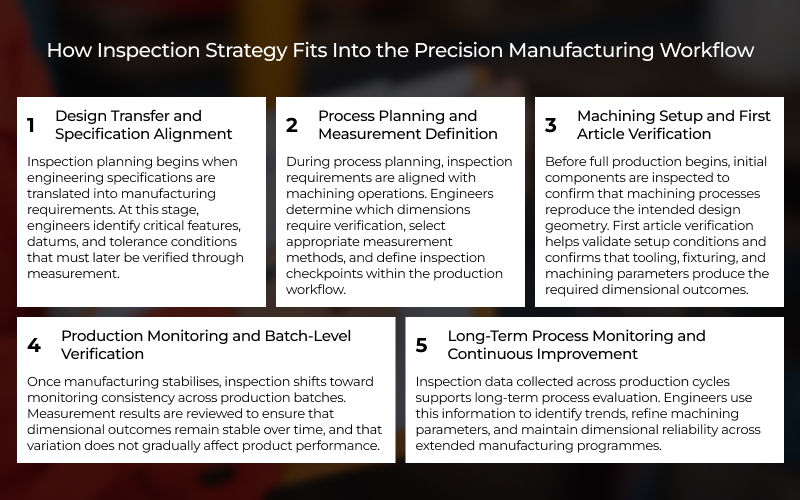
At Disk Precision Thailand, the inspection strategy is approached as a lifecycle discipline rather than a single checkpoint performed after machining. Precision components often move through several stages of production before reaching stable, repeatable manufacturing. Inspection planning, therefore, evolves alongside the product lifecycle, supporting engineers as they move from early validation to long-term production stability.
During the early phases of production, inspection activities focus heavily on validation and process understanding. Initial production runs allow engineers to verify that machining processes meet the design intent and to identify potential variation patterns that may emerge over time. These early insights allow manufacturers to adjust tooling parameters, fixturing conditions, and process settings before production volumes increase.
As production matures and manufacturing conditions stabilise, the focus of inspection shifts toward sustaining consistency rather than exploring unknown variables. At this stage, verification processes function as a control mechanism for dimensional variation, ensuring that the dimensional performance demonstrated during validation is maintained as production volumes increase.
Lifecycle Considerations
Several lifecycle considerations shape how inspection planning evolves. Initial production runs provide valuable insights into process capability and potential dimensional behaviour. Engineers analyse early measurement data to understand how parts respond to machining conditions and to identify which critical tolerances must be monitored.
Once these patterns are understood, ongoing inspection confirms that the established behaviour remains stable across future batches. Measurement data collected over time provides engineers with evidence that the manufacturing process continues to perform within expected limits.
Inspection data also supports engineering decision-making when product designs, material specifications, or production volumes change. Even small adjustments to machining parameters can influence dimensional outcomes. A well-defined verification framework ensures that these changes are evaluated carefully before they affect production reliability.
As manufacturing programmes mature, inspection planning often shifts from exploratory measurement to assurance-based monitoring. The emphasis moves toward confirming that previously validated processes continue to operate within stable parameters. This transition reflects increasing confidence in process capability rather than a reduction in scrutiny.
Inspection planning also aligns closely with machining capabilities used in advanced production environments. For example, while multi-axis machining processes enable complex geometries to be formed in fewer setups, they also demand thorough verification to ensure feature relationships remain accurate.
When complex components are produced using multi-axis machining or simultaneous five-axis operations, small variations in fixturing, tooling, or machine positioning can influence multiple features simultaneously. Structured inspection planning, therefore, focuses on verifying the spatial relationships between critical features rather than measuring each dimension in isolation.
Through disciplined inspection planning, Disk Precision Thailand ensures that critical features are measured according to their functional importance, supporting reliable precision across production sites.
Industry Context
For Thailand-based precision engineering companies that support long-term global programmes, lifecycle-aware inspection provides an important foundation for operational continuity. International customers often rely on suppliers for years of consistent production. Maintaining reliable verification processes ensures that dimensional performance remains stable throughout the entire supply relationship.
This approach also supports long-duration programmes where product designs, materials, or production schedules may evolve. By maintaining structured verification frameworks, manufacturers can manage these changes without compromising part reliability.
Lifecycle-based inspection planning, therefore, plays an important role in preserving dimensional consistency at scale. Insights gained during early production runs can be translated into stable monitoring practices that support high-volume manufacturing across large batches and extended production timelines.
Inspection Strategy and Dimensional Consistency at Scale
Disk Precision Thailand recognises that true precision engineering performance is measured by consistent results across hundreds or thousands of produced parts, rather than by isolated samples. Individual components may meet dimensional requirements during initial inspection, but long-term reliability depends on consistently maintaining those results over extended production cycles.
For this reason, verification processes define how consistency is monitored, interpreted, and validated over time. By analysing measurement results across multiple batches, engineers can identify early signs of variation and take corrective action before issues affect product performance.
Key Themes
One key theme within precision manufacturing is that repeatability represents the true benchmark of quality. A machining process that only occasionally produces accurate results is far less valuable than one that delivers stable performance across large production runs. Through systematic inspection monitoring, manufacturers gain visibility into whether machining conditions remain stable across different shifts, production lots, and facilities.
Inspection also plays an important role in identifying early signs of process drift. Gradual dimensional changes may not be immediately visible in individual measurements, but trend analysis can reveal patterns that indicate tool wear, fixture movement, or environmental influences. When these signals are detected early, engineers can intervene before variation escalates into nonconformance.
Inspection data enables engineers to take corrective action before failures occur. This capability becomes especially important as production complexity increases and manufacturers manage multiple product variants, production schedules, or mixed-batch manufacturing.
From the customer’s perspective, documented inspection data provides a reliable substitute for physical oversight. International clients working with suppliers in Thailand often rely on measurement documentation to confirm that manufacturing standards are being maintained. Transparent inspection records, therefore, help build confidence in multi-site production environments where customers may not always be present on site.
In this context, reliable verification practices support not only technical quality but also supply chain trust. When inspection processes are well structured and consistently applied, customers gain assurance that dimensional performance is being monitored with discipline.
This approach is particularly important in industries that require complex geometries and extremely tight tolerances. For example, manufacturers of CNC-machining aerospace parts must maintain strict dimensional control, as even minor deviations can affect assembly alignment and aerodynamic performance. Consistent inspection planning, therefore, plays a critical role in maintaining long-term reliability for these specialised components.
Assurance in Outcomes Through Structured Inspection Planning
A well-defined verification framework often reflects the maturity of an engineering organisation. When inspection planning is structured and intentional, it demonstrates that dimensional outcomes are being managed proactively rather than being left to chance.
At Disk Precision Thailand, structured inspection planning signals that precision outcomes are deliberate and controlled. Inspection activities are aligned with engineering intent, so that measurement focuses on the features that truly influence functional performance.
This alignment ensures that dimensional verification supports the component’s functional behaviour, rather than merely confirming isolated measurements. By prioritising functionally critical characteristics, inspection activities contribute directly to long-term reliability and product stability.
Indicators Of A Mature Inspection Strategy
Several indicators help distinguish a mature inspection framework. One of the most important is alignment between critical design features and inspection priorities. Measurement activities should focus on dimensions that govern fit, alignment, and operational performance rather than simply measuring features that are easy to access.
Consistency in interpreting engineering specifications is another important factor. Inspection teams must apply measurement standards consistently so that dimensional data remains comparable across production batches and inspection personnel.
A mature inspection framework also includes a clear rationale for inspection frequency and measurement scope. Engineers must determine which dimensions require continuous monitoring and which can be verified through periodic checks determined by process capability analysis.
Assurance within precision manufacturing is measured through verified repeatability, low dimensional variation, and documented control over critical features. These indicators demonstrate that manufacturing processes consistently deliver stable results over extended production cycles.
It is also important to recognise that assurance differs from simple compliance. While compliance confirms that a part meets its dimensional requirements at a specific moment in time, assurance demonstrates that the manufacturing process is consistently capable of maintaining those results.
Delivering measurable assurance sends a strong signal of engineering maturity. For companies operating in regulated or high-performance sectors, this level of discipline is often required before suppliers can participate in advanced manufacturing programmes.
Structured inspection planning also complements advanced machining capabilities, such as 5-axis CNC services, enabling the efficient production of complex geometries with high precision. When combined with disciplined verification processes and comprehensive precision machining solutions, these capabilities allow manufacturers to maintain dimensional reliability even for highly complex components.
In high precision industries, confidence in dimensional outcomes does not arise solely from machining capability. It emerges from the combined strength of machining expertise, process control, and structured verification. By integrating these elements throughout the production lifecycle, manufacturers create a stable foundation for delivering consistent precision outcomes across global supply chains.
Questions You Might Ask
Why isn’t machining accuracy alone enough in precision engineering?
Machining accuracy reflects what machines and processes are capable of producing under controlled conditions, but it does not automatically confirm that those outcomes are achieved consistently in real production environments. Dimensional results are influenced by variables such as material behaviour, thermal conditions, machine performance, and cumulative variation across batches. Without a structured verification framework, these influences may remain unseen, creating a gap between assumed accuracy and verified performance. A disciplined verification approach ensures that machining accuracy translates into repeatable, reliable dimensional outcomes over time.
How does the inspection strategy affect supplier reliability?
Through structured planning, a supplier can detect, understand, and manage variation before it impacts part performance or downstream assembly. A structured approach to inspection reflects a deeper understanding of dimensional risk, critical features, and consistency requirements. Suppliers with well-developed inspection strategies are better positioned to identify early signs of deviation, maintain stable production output, and prevent quality escapes. Disk Precision Thailand initiates inspection planning during early production runs, prioritises critical features based on their functional impact, and reviews batch-to-batch consistency to maintain reliability.
Why do global customers place so much emphasis on inspection documentation?
Inspection documentation provides evidence of how dimensional accuracy is verified, monitored, and maintained across production cycles. For global customers, documentation supports traceability, accountability, and transparency, reinforcing confidence in long-term manufacturing performance.
How does Disk Precision Thailand approach inspection strategy differently?
Disk Precision Thailand integrates inspection strategy directly into its precision engineering approach, aligning inspection planning with dimensional criticality, consistency expectations, and customer requirements. This ensures that verification efforts support functional reliability, assurance in outcomes, and long-term trust rather than serving as a standalone compliance exercise. Concrete behaviours include initiating inspection planning at the design-transfer stage, prioritising functionally critical features first, and continuously reviewing performance across multiple batches to maintain consistency across sites.
Conclusion

Precision engineering is ultimately defined by what can be consistently demonstrated and verified, not simply by what can be produced under ideal machining conditions.
While advanced machining technologies allow manufacturers to target extremely tight tolerances, long-term manufacturing success depends on whether those results can be measured, validated, and reproduced across production cycles. In industries that depend on high-reliability components, it is just as important to demonstrate dimensional performance as it is to achieve it.
Machining capability establishes the technical potential of a manufacturing process, but a structured inspection strategy determines whether that potential is consistently realised in real production environments. Through systematic verification and disciplined measurement planning, manufacturers gain the visibility needed to understand variation, maintain stability, and protect downstream performance.
In Thailand’s role as a global manufacturing partner supporting automotive, electronics, industrial automation, and aerospace supply chains, the verification discipline is closely linked to engineering credibility. International customers increasingly evaluate suppliers not only on their machining capabilities, but also on their ability to consistently and confidently demonstrate dimensional accuracy over time.
Disk Precision Thailand recognises that reliable precision outcomes require more than advanced machining alone. A well-defined inspection strategy provides the framework that supports dimensional reliability, traceable verification, and sustained production confidence across large manufacturing programmes.
For organisations evaluating precision engineering partners, understanding how dimensional performance is verified can provide valuable insight into long-term manufacturing reliability. Engaging Disk Precision Thailand during the early planning stages of a production programme allows engineering teams to align expectations on dimensional verification, inspection methodology, and consistency monitoring. This early alignment helps reduce uncertainty, improves production readiness, and supports stable manufacturing outcomes throughout the supply relationship.


ความคิดเห็น